Complete Guide to Ausbildung in Germany
Everything Indian students, graduates, and working professionals need to know about Germany’s Dual Vocational Training: legal frameworks, 350+ certified trades, salary ladders, visa rules (Section 16a), and permanent residency.
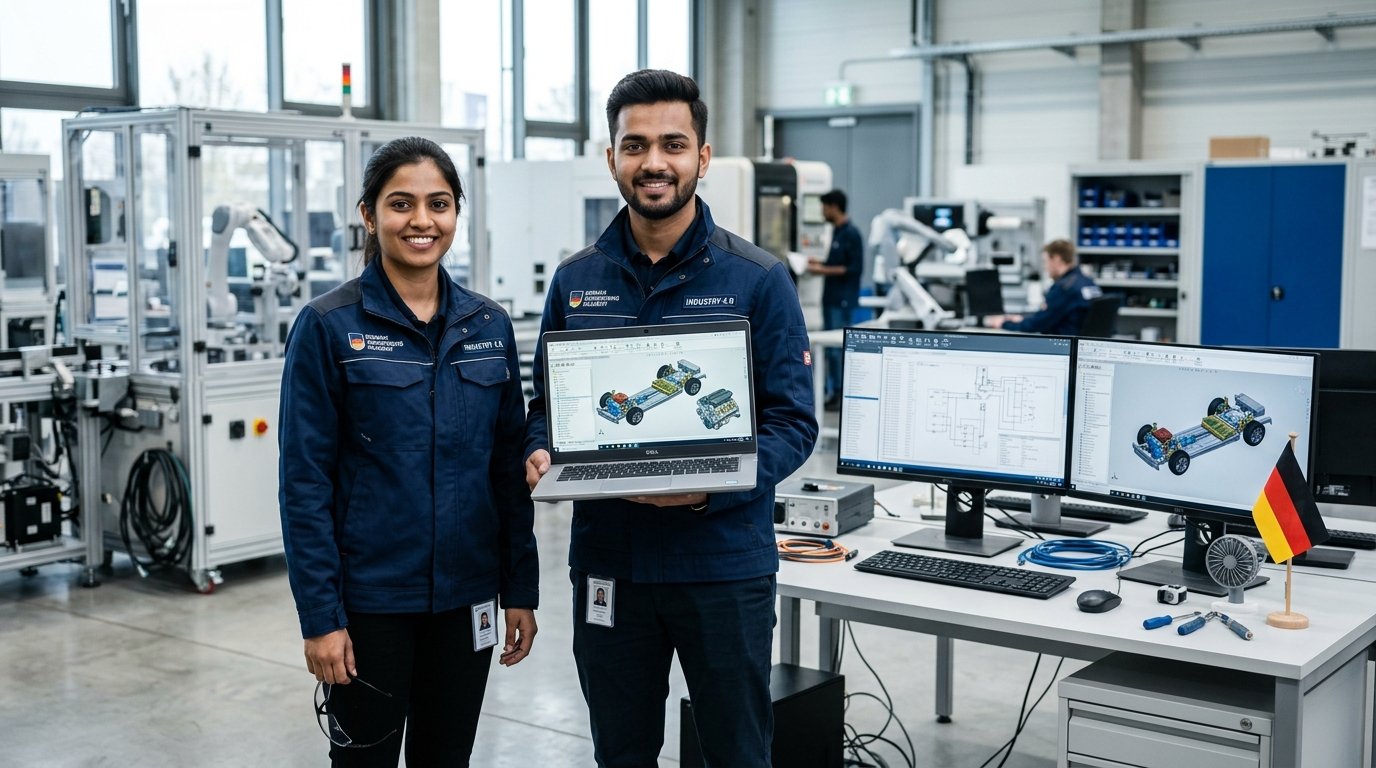
The Architecture of Germany’s Dual Education System
The Dual Vocational Training system (Duale Ausbildung) is anchored in German Federal Law under the Vocational Training Act (Berufsbildungsgesetz - BBiG). It is the primary engine behind Germany’s economic stability and industrial pre-eminence in Europe.
The Ausbildungsbetrieb (Employer)
Signs a binding 3-year contract with you. Provides structured on-the-job training, assigns dedicated certified mentors (Ausbilder), covers your social security, and pays your monthly stipend.
The Berufsschule (State College)
State-funded vocational college. You attend free of charge for 1–2 days/week or in 2–4 week block periods (Blockunterricht). Teaches technical theory, economics, social studies, and business German.
The Chambers (IHK / HWK)
The Industrie- und Handelskammer (IHK) or Handwerkskammer (HWK) monitors training quality, registers your training contract, and conducts standardized nationwide intermediate and final examinations.
German Dual Qualification Recognition: An Ausbildung certificate (Gesellenbrief or IHK-Abschlusszeugnis) is recognized across all 27 European Union member states and is equivalent to European Qualification Framework (EQF) Level 4.
Detailed Trade Profiles & Monthly Stipend Ladders
Monthly stipends increase each year of training. Here is the realistic breakdown for the highest-paying and most popular trades in Germany.
1. Nursing & General Healthcare Specialist
Key Responsibilities & Scope:
Delivering patient care across hospital wards, surgical clinics, outpatient centers, and geriatric rehabilitation. Administering doctor-prescribed medications, tracking telemetry, and assisting in surgeries. Germany reformed nursing in 2020 (Generalistische Pflegeausbildung), making this certificate valid across all age groups from pediatrics to elderly care throughout Europe.
Post-Graduation Outlook:
Starting full-time salary: €38,000 to €45,000 per year (~₹34–₹41 Lakhs) + shift allowances. Rapid progression to Ward Manager (Stationsleitung) or Specialized Clinical Specialist.
2. IT Specialist in Application Development & System Integration
Key Responsibilities & Scope:
Coding in modern languages (Java, Python, C#, JavaScript, SQL), designing enterprise relational databases, building automated cloud architectures (AWS/Azure), and managing cyber-defense pipelines for German tech corporations and Mittelstand companies.
Post-Graduation Outlook:
Starting full-time salary: €42,000 to €52,000 per year (~₹38–₹47 Lakhs). Rapid eligibility for the German EU Blue Card as a tech specialist.
3. Hotel Management & Hospitality Specialist
Key Responsibilities & Scope:
360-degree training across front office, concierge, guest relations, revenue accounting, events, and F&B operations. Major hotel groups (Marriott, Hilton, Steigenberger, Accor) frequently offer subsidized company staff accommodation and complimentary meals to international trainees.
Post-Graduation Outlook:
Starting full-time salary: €32,000 to €38,000 per year. Fast-track pathway to Assistant General Manager or Event Director.
4. Automotive & Industrial Mechatronics
Key Responsibilities & Scope:
Assembly, maintenance, sensor diagnostics, and repair of cutting-edge automotive systems, industrial robotics, automated factory machinery, and electric vehicles (EVs). Work at German industrial hubs alongside master engineers.
Post-Graduation Outlook:
Starting full-time salary: €36,000 to €46,000 per year. Can further qualify as state-certified Master Technician (Meister) or pursue a sponsored Bachelor of Engineering.
Eligibility Requirements & Documentation
German vocational schools assess your readiness on three primary pillars: your academic background, your certified German language proficiency, and complete verified documentation.
1. Academic Qualifications
- 12th Pass: From CBSE, ICSE, or any recognized Indian State Board with minimum 50% aggregate.
- Polytechnic Diploma: 3-year diploma after 10th or 12th.
- Graduates: Bachelor's degree holders (B.Sc, BBA, B.Com, BA, BCA, B.Tech) are fully eligible.
2. German Language Proficiency
- Minimum Threshold: B1 Certified for Hospitality, Logistics, Trades.
- Recommended Level: B2 Certified for Healthcare, IT, and Client-Facing Occupations.
- Accepted Certificates: Goethe-Zertifikat, telc Deutsch, ÖSD, or ECL.
3. Age Criteria
- Prime Bracket: 18 to 28 years (optimal for standard intake).
- Shortage Occupations: Up to 35+ years for Nursing and Critical Healthcare tracks.
- Career Switchers: Permitted with a clear letter of motivation (Motivationsschreiben).
Mandatory Application Checklist:
The 8-Stage Execution Roadmap (Timeline Breakdown)
A typical Ausbildung journey takes between 8 to 11 months from start to arrival in Germany. Here is how your schedule is structured with Konversa Global:
Profile Profiling & Trade Selection
Complete the Readiness Check. Consultation with senior Germany advisors to evaluate qualification equivalence and lock in your target trade.
Intensive German Language Training (A1 & A2)
Live interactive coaching 5 days a week. Core vocabulary, daily conversational drills, grammar mastery, and official Goethe/Telc mock exams.
B1 German Exam & Document Legalization
Clear your official B1 examination. In parallel, our operations desk processes your certified German translations, MEA apostille, and school equivalency filings.
German CV & Cover Letter Curation
Crafting your customized Lebenslauf and trade-specific Anschreiben according to DIN 5008 German business standards.
German Employer Virtual Video Interviews
Direct interview matching with vetted German hiring partners (hospitals, hotels, IT departments, and engineering firms) with pre-interview mock coaching.
Signing Ausbildungsvertrag & School Admission
Receipt of your legal German Training Contract (Ausbildungsvertrag) and vocational school confirmation letter (Schulplatzbestätigung).
National Visa Application (Section 16a AufenthG)
Submission at the German Embassy / VFS Global. Our visa experts review every line of documentation to maintain our 97%+ visa success rate.
Pre-Departure Briefing, Flight & Welcome in Germany
Briefing on German cultural etiquette, city registration (Anmeldung), German health insurance card, bank account setup, and reporting to your employer.
Financials, Monthly Net Income & Blocked Account Rules
One of the greatest advantages of an Ausbildung compared to university studies is the substantial financial relief it provides to candidates and their families.
Why You Do NOT Need an €11,904 Blocked Account
Under German Immigration Code § 16a AufenthG (Vocational Training Visa), applicants must demonstrate proof of monthly subsistence (currently approx. €903 to €992 per month net). Because your training company pays you a monthly contract stipend (often €1,000 to €1,400 gross), your signed contract acts as proof of financial sustenance. You are NOT required to block ₹10.5 Lakhs in an upfront German blocked account!
Typical Monthly Budget Example (Healthcare Trainee, Year 1):
Career Progression, Starting Salaries & German PR
Ausbildung is not just a training course—it is the most reliable, direct fast-track to permanent European residency for Indian professionals.
Immediate Full Employment
Upon passing your final exam, your trainee contract seamlessly upgrades to a full German employment contract with salary starting from €32,000 to €48,000/year.
Permanent Residence (PR)
Under § 18c AufenthG, international trainees who completed vocational training in Germany can apply for the Niederlassungserlaubnis (German PR) after just 24 months of paying pension contributions!
German Citizenship (Passport)
Under Germany’s modernized 2024 Citizenship Act (StARModG), individuals with B1+ German and secure employment can obtain German citizenship in just 5 years (or 3 years with exceptional integration).
Frequently Asked Questions
Detailed answers to the most important questions about Germany's Ausbildung programs.
Is there any tuition fee to be paid to the vocational school?
Can I bring my spouse or family members to Germany during Ausbildung?
Can I do extra part-time work alongside my Ausbildung?
What if I fail a vocational school exam?
Which intakes are available for Ausbildung programs in Germany?
Evaluate Your Profile with the Free Readiness Check
Calculate your exact score out of 100 based on German vocational criteria, uncover your key strengths, and download your personalized roadmap.